
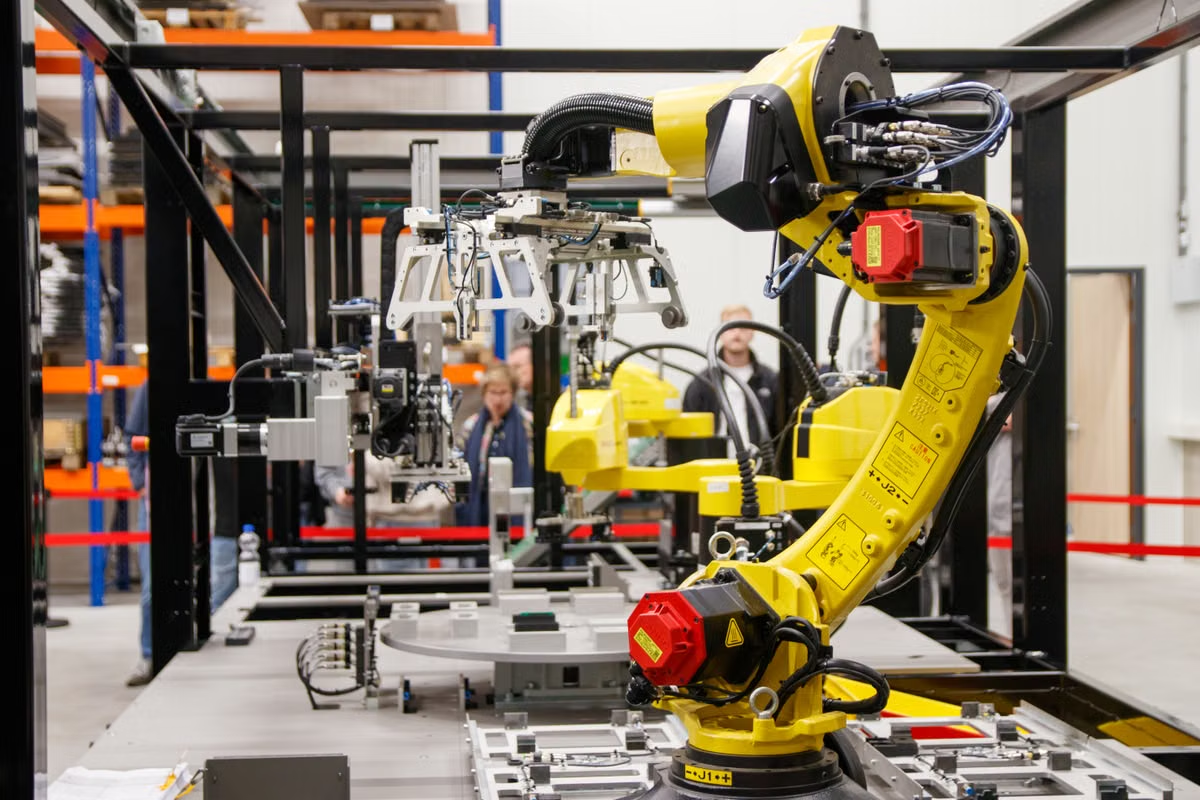
Start with the data, then assess your plant
IFR reports that five million industrial robots were operating in factories worldwide in 2025, according to its September 24, 2026 release of World Robotics 2026 data (IFR’s release). This is useful market context, not a purchasing instruction: robot deployment figures do not establish that a particular factory needs a robot, an AI vision system, or both. The actionable move is to shortlist measurable tasks at your plant, verify whether vision solves a defined problem, and test the required interfaces and maintenance process before approving a project.
This article is for robot integrators translating industry trends into customer requirements.
It is for factory automation engineers deciding which operations are suitable for robotic improvement.
It is for technical decision-makers separating global deployment data from evidence for a local investment.
Last updated October 2, 2026. The report date, stated total, and statistical wording were checked against IFR’s official release. Confirm the definition and reporting year whenever you reuse the figures; operating stock, annual installations, and forecasts are not interchangeable.
Read the report as context, not a plant-level forecast
The reported figure describes industrial robots operating in factories worldwide in 2025. It is a global stock measure, not a count of robots installed during that year, a forecast of future purchases, or a tally of vision-equipped systems. IFR’s public release is useful for understanding the scale of deployment; the full report and its charts provide additional context, but neither tells an individual plant what its return on investment will be.
| What the report can support | What it cannot establish for your plant |
|---|---|
| A view of the scale of industrial robot use, using IFR’s stated reporting scope | The number of robots or cameras your production line needs |
| A reason to review whether repeatable work is a candidate for automation | Whether a fixed program, robot guidance, inspection vision, or no vision is the right design |
| A prompt for integrators to discuss automation trends with customers | Your achievable cycle time, defect-detection performance, payback, or maintenance cost |
Keep the distinction clear when presenting a business case. Industry growth can justify investigating a use case, but the investment case still depends on local labor and process conditions, product variation, quality requirements, safety constraints, and integration effort. IFR’s 2025 industrial robot executive summary can help readers compare reporting categories across editions; it should not be used to turn a global trend into a factory-specific performance claim.
What reference value does IFR World Robotics 2026 have for a factory automation project? It gives the team a documented market backdrop and a common starting point for a discussion about automation. It does not replace a line walk, process data, a risk assessment, or a trial using representative parts. Treat it as a reason to ask better project questions—not as the answer to them.
A common planning error is to move directly from “robot use is widespread” to “our operation needs robot vision.” That skips the important distinction between a robot task and a vision task. A robot may repeat a taught path without a camera when part presentation is controlled. Vision is worth investigating when the process has a specific, recurring localization, identification, or inspection requirement that fixed positioning does not address reliably.
Match repeatable operations to the actual positioning problem
Start with the workpiece and its presentation, not with a camera or model. Document where parts arrive, how their position or orientation varies, whether the robot can reach them, and what happens when the part is missing, damaged, or outside the expected range. If trays, fixtures, or hard stops already place each part consistently, a fixed robot program may be simpler to validate and maintain.
When positioning does vary, identify the variation precisely. A part may shift within a bin, arrive in several orientations, or change between product variants. Those are different problems. A camera that detects position does not automatically identify the product, confirm its quality, or determine whether it can be safely grasped. The required output should be defined before the sensor and software are selected.
| Observed condition | First option to evaluate | Evidence to collect before adding vision |
|---|---|---|
| Parts arrive in a stable fixture and the location does not change materially | Fixed robot program | Confirm repeatable part presentation and record exceptions that stop or disrupt the cycle |
| Part location changes but the part type is known | Position or pose guidance | Capture representative positions, occlusions, lighting changes, and grasp outcomes |
| Product variants share a station | Identification plus the appropriate robot recipe | Check how variant identity is supplied, how ambiguous reads are handled, and where the selection is recorded |
| Part identity or position is uncertain and errors affect downstream work | A vision trial with defined fallback handling | Establish a labeled test set and specify what happens when confidence or image quality is insufficient |
A vision system may reduce reliance on precise fixturing, but it adds its own dependencies: stable image capture, controlled lighting, suitable optics, software version management, and a way to recover when the scene falls outside tested conditions. It can also introduce integration work between the camera, robot controller, programmable logic controller, production system, and operator interface. These are project requirements, not incidental details to leave until commissioning.
Can robot installation growth alone justify AI vision in a factory? No. Growth in robot deployment says nothing by itself about part variation, error costs, inspection needs, or whether a camera can resolve the plant’s specific problem. Require a defined failure mode and compare a vision trial with simpler alternatives, such as improved part presentation, a fixture change, or a revised robot sequence.
Turn quality inspection into an acceptance task
Inspection projects need a narrower definition than “use AI to find defects.” Name the product and surface, define the defect classes that matter, identify which defects are outside scope, and document how the inspection result changes the process. If a failed inspection only produces an unreviewed signal, the system may detect defects without improving the quality decision.
Before integrating the result with a robot cell, agree on how the team will test it. Select representative images and parts, including normal variation and known defect examples. Have qualified personnel review labels, because inconsistent reference decisions can make a model appear unreliable—or make a weak model look acceptable. Separate the model’s output from the final disposition rule: an uncertain result might trigger a second image, a manual review, a controlled stop, or a defined reject path.
| Inspection question | Project decision to write down | Verification evidence |
|---|---|---|
| What exactly is inspected? | Product, region, defect type, and exclusions | Approved sample set and documented label review |
| What happens after a pass or fail? | Signal destination and production response | End-to-end test through the controller or quality workflow |
| What happens when the result is uncertain? | Manual review, retry, hold, or other fallback | Test cases for ambiguous images and communication loss |
| Who can change the model or criteria? | Approval, access, and version-control process | Change record and repeatable revalidation procedure |
Do not promise a detection rate or cycle time before the team has tested a representative sample and defined the measurement method. The acceptance plan should state how false accepts and false rejects will be counted, who reviews disputed cases, and how changes to lighting, product finish, or camera position trigger a recheck. The result should also be visible to the people responsible for production and quality; an inspection decision that cannot be traced is difficult to diagnose when results change.
For system boundaries, the OPC Foundation’s machine-vision information model describes a structured way to represent machine-vision information and interfaces. Its machine-vision use-case material can help teams discuss how vision functions fit into a larger automation system. These references do not select a particular product or guarantee interoperability. They help make interface expectations explicit early enough to test them.
Separate warehouse identification from navigation
Warehouse and material-flow projects are often grouped under “robot vision,” although their tasks can be very different. A station may need to read a label, identify a tote, locate an object for picking, sort items, or navigate a route. A single camera or model should not be assumed to handle all of those tasks. The sensing method depends on the environment, the required decision, and the vehicle or robot system that consumes the result.
| Operational need | Vision-related question | Site condition to check |
|---|---|---|
| Identify a container or material | What identifier must be read, and what happens when it cannot be read? | Label placement, wear, reflections, and variation in orientation |
| Locate an object for pickup | What position or pose does the robot need to receive? | Occlusion, stacking, background variation, and grasp access |
| Sort material into destinations | Which attributes determine the destination? | Routing rules, exception handling, and the system of record |
| Move through a warehouse | Does the system need visual localization, obstacle response, or both? | Changing layout, people and vehicle interaction, restricted zones, and safety controls |
Before selecting equipment, walk the route and operating area under realistic working conditions. Check for changing light, reflective packaging, dust, floor markings, moving obstructions, and changes in stored inventory. Then identify where safety-rated controls are required and which system owns each safety action. OSHA’s technical manual on industrial robot system safety is a reference for reviewing robot-system hazards; a vision model should not be treated as a substitute for the cell’s safety design.
Also map the interfaces. Identify what information the vision system sends, who consumes it, how timestamps or part identity are handled, and what the cell does when communication is interrupted or data is invalid. The NIST robotic systems for smart manufacturing program provides broader context on robotics in manufacturing systems. For a project team, the practical implication is to evaluate the robot, sensing, controls, and production workflow as one operating system rather than isolated components.
Convert the trend into a site assessment
Use the report to decide whether a closer look is worthwhile. Use plant evidence to decide whether to proceed. A lightweight assessment can be completed before selecting a robot or requesting a detailed vision-system quote.
- Shortlist repeatable work. Record tasks with frequent manual positioning, repetitive handling, inspection, or sorting. Note the product variants and exceptions rather than describing the operation only by its average case.
- Describe the failure or variation. State what goes wrong today, where it happens, and what the consequence is. Separate a localization issue from a defect-inspection issue or a navigation issue.
- Check the baseline and available data. Review existing images, quality records, production events, and operator decisions. Confirm that the data represents real shifts, products, and operating conditions.
- Map interfaces and ownership. Identify the robot or vehicle controller, PLC, production system, quality workflow, and staff responsible for each connection. Define recovery behavior for missing, invalid, or delayed results.
- Write acceptance conditions before the trial. Agree on sample selection, review responsibilities, false-accept and false-reject handling, the response to uncertainty, and how changes will be revalidated.
- Estimate support and maintenance work. Assign responsibility for cleaning, lighting checks, software updates, model changes, backups, and fault diagnosis. If no one owns those tasks, a technically successful pilot may still be a poor production fit.
How can an integrator turn robot deployment trends into a vision project requirement list? Start with the customer’s process, then record the specific operation, observed variation, required vision output, system destination, safety boundary, fallback behavior, and acceptance evidence. The industry trend can help open the conversation; those plant-level details make the requirement testable.
Use this conditional decision list to determine the next step:
- If the part position is controlled and the fixed program is repeatable, then test the fixed-program approach first; do not add vision without a documented failure it must solve.
- If part location or orientation varies and causes a measurable handling problem, then evaluate a vision-guided trial using representative scenes and an agreed fallback.
- If the main requirement is defect detection, then define defect classes, sample review, and disposition rules before connecting model output to robot action.
- If the task is warehouse movement, then separate identification, picking, sorting, and route behavior before specifying sensors or software.
- If interfaces, safety ownership, or maintenance responsibilities remain unclear, then pause equipment selection and close those gaps first.
For readers building a broader architecture plan, the next useful step is to compare the proposed system with the site’s existing control and compute environment. The Vuncloud help center provides service and support information for teams assessing a temporary development or test environment. Keep infrastructure questions separate from the robot application’s acceptance criteria, and document how development and test systems connect to production equipment before any trial begins.
Decide what should happen next
A trend report can help an integrator explain why automation deserves attention, but a defensible project still begins with a site problem. For a factory robot vision project, the decision should follow the evidence: the work is repeatable or its variation is understood, the vision task has a clear output, the output reaches the right system, uncertain results have a safe disposition, and maintenance has an owner.
The existing approach may leave operators repeatedly repositioning parts, rely on fixtures that limit product flexibility, or send inspection results into a manual process with weak traceability. Those are real costs to examine, but they do not prove that every production station needs AI or a new robot. A Mac is also not a drop-in replacement for an industrial controller or a validated real-time vision appliance. It may, however, suit temporary model development, software testing, or a separate engineering workflow when the toolchain supports it. If that is the specific need, compare the constraints of the test environment with Vuncloud’s Mac mini rental options; keep production control, safety, and acceptance testing on the systems designed for those duties.
Turn Robotics Trends Into a Practical Project Plan
Map one repeatable production or warehouse task and identify where vision could reduce manual checks or variation.
Measure your current cycle time, defect rate, and exception volume before choosing a solution.