Technical Insights &
OpenClaw Guides
Explore macOS cloud development possibilities and get the latest automation deployment solutions.

Create a regular Google Account, then verify you are a real person by phone. US Play follows location and a payments profile, not a country checkbox at signup; country changes wait at least 90 days.

Astra shipped on September 3 — it is not a September 29 debut. Agents API public beta plus the openai_hosted sandbox already run; watch GA, pricing, and Codex default notes that day.

Only two boxes stay always-on at $0: Oracle Always Free (now 2 OCPU / 12GB) and GCP e2-micro. The rest are trials, sleeping PaaS, or shared hosting with SSH.

US eSIM mixed day still ~18% at 11pm; mainland ~14%. The 36-hour claim is local video, not short-form; gaming ~21% per hour.

Apple has not published a per-person cap. Primary sign-in numbers are 1:1; trusted numbers and iMessage are separate rules. The popup you actually hit is usually a device's yearly free iCloud quota.

No invite yet. Bloomberg’s October window still points to a 24-inch M6 iMac, a 14-inch entry-level MacBook Pro, and an OLED iPad mini. A high-end OLED touch MacBook looks more like late 2026 or early 2027—do not lock the budget to October.

US official credit tops out at $885; mainland China needs the old phone received within 14 days of the new one. Estimate first, order next, turn off Find My only after the new iPhone is set up.

Day-after notes on four phones: overnight drain about 8–15% extra, heat is mostly indexing; 15 Pro and newer stay smooth, older phones should tone down Liquid Glass. Wait 48 hours before judging.

Ship-day bill: Developer about $8/month, 25 hours of Xcode Cloud included, amortized Mac mini, plus Cloud Mac at $101.7 versus GitHub Actions macOS.

Apple confirmed Monday, September 14. Around 10:00 a.m. Pacific / ~1:00 a.m. Beijing on the 15th, three compatibility tiers, and Siri AI availability for mainland China and the EU.

After the keynote: official prices in four markets—US $1,199, China RMB 9,999, Hong Kong HK$10,499, Japan ¥219,800. 256GB is only one step up; 1TB/2TB is where the invoice gets ugly. eSIM, warranty, and who should skip launch night.

Surprise and Shine is done. Launch-spec rundown of iPhone Ultra: starting price around $1,999, 7.8″ inner display, 4.5mm unfolded thickness, liquid-metal hinge, dual 48MP cameras, and dual-cell battery—plus which numbers still wait on Apple’s product page.

One day before Surprise and Shine. A rumor roundup of the foldable iPhone Ultra: starting price around $2,000+, 7.8″ inner display, crease, A20 Pro, and launch timing—plus what is actually confirmed.

OpenAI launched flagship GPT-6 Astra on September 3. The API ID is gpt-6-astra at $10/$50 standard. Plus uses it in Work and Codex; GPT-6 Pro in standard Chat is reserved for higher plans. This guide follows official docs on features, billing traps, and when to upgrade.
This guide helps individual developers, startups, and engineering managers estimate AI Agent costs before choosing an API, rented cloud capacity, or a local or remote Mac environment. It separates usage fees, utilization, operations, migration, compliance, and interruption risks so the buying decision can be updated when real prices change.

Four days to Surprise and Shine. Confirmed session time, A20 Pro specs, variable-aperture camera, price bands, and the rest of the lineup—what is locked vs still rumor.
This guide helps local AI developers, coding teams, and Mac buyers decide whether an M6 Mac mini can handle their intended models. It explains memory pressure, model loading, context length, concurrency, remote operation, and when a rented Mac environment is the safer test path.
This guide helps cross-border operators decide whether to create a separate US Apple Account or change an existing region. It follows the process from preparation and overseas Mac checks to verification, team management, and troubleshooting.
This guide helps developers and operators expose Ollama on a Mac to an IDE, another computer, or an internal automation service without treating network reachability as security. It covers OLLAMA_HOST, the Ollama API, protected network entry points, macOS startup behavior, logging, and recovery validation.

The invite locks 9 September, Surprise and Shine. What is confirmed vs rumored for 18 Pro, the foldable, and iOS 27 Siri AI—plus an event-week checklist for developers.

M6 vs M4: +40% CPU, 2× GPU, 4× AI, 2× SSD, Wi-Fi 7 & 2.5Gb Ethernet. Side-by-side specs and scenarios—should M4 owners pay +$100 to upgrade, or use Cloud Mac instead?

Apple launched the M6 Mac mini on Aug 25, 2026—from $899, shipping Sep 22. Covers M6/M5 Pro configs, the $100 hike over M4, 40% CPU and 4× AI gains, plus upgrade, wait, or Cloud Mac rent decisions.
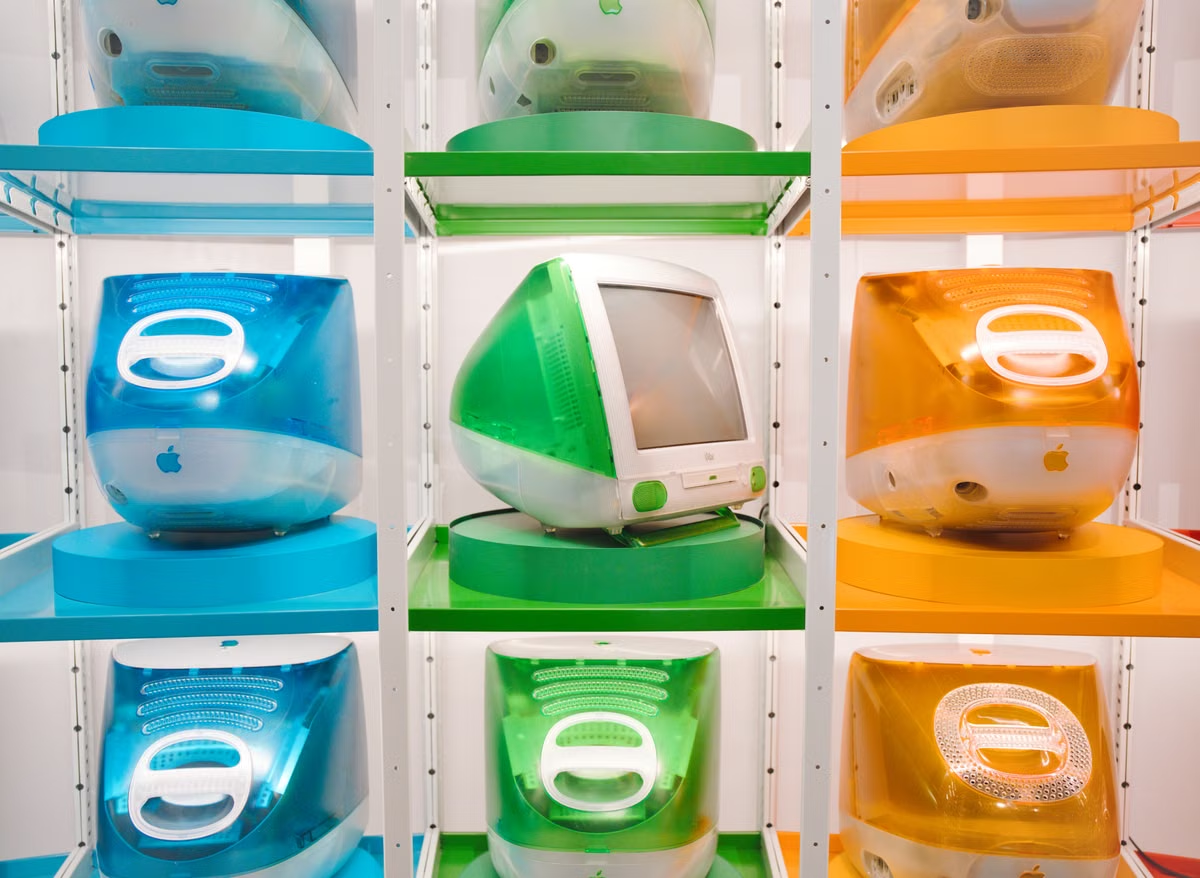
This guide evaluates the latest M6 iMac reports through release timing, cost, configuration, display, and color indicators. It explains what remains unconfirmed and helps home users, office teams, designers, and developers decide whether to wait or buy an available desktop Mac.
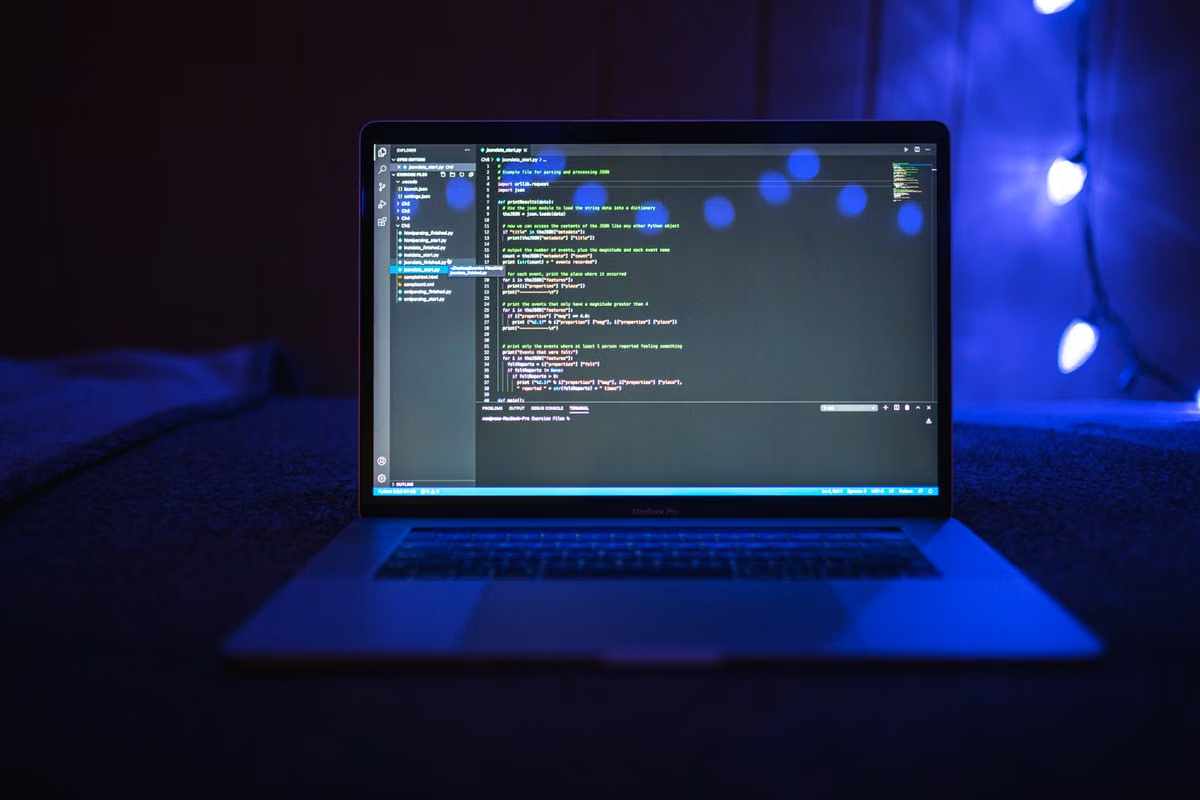
This guide helps iOS and macOS developers decide whether a generative AI task belongs on the device, in Private Cloud Compute, or behind an existing model service. It compares privacy, context, reliability, tool access, and migration risk, then provides a first-week validation plan for teams evaluating the WWDC26 APIs.

SWE-bench Verified 79% vs 88.6%, 89× output token price gap. Run agent loops on Flash; pay for Opus 4.8 when first-pass fixes matter—benchmarks, pricing, and Cloud Mac tips inside.

No invite yet. Most likely: 9 Sep keynote, 12 Sep pre-order, 18 Sep sale. US starting price rumored at $1,299–$1,399. The yearly jump is 2nm A20 Pro, variable aperture, and on-device AI.
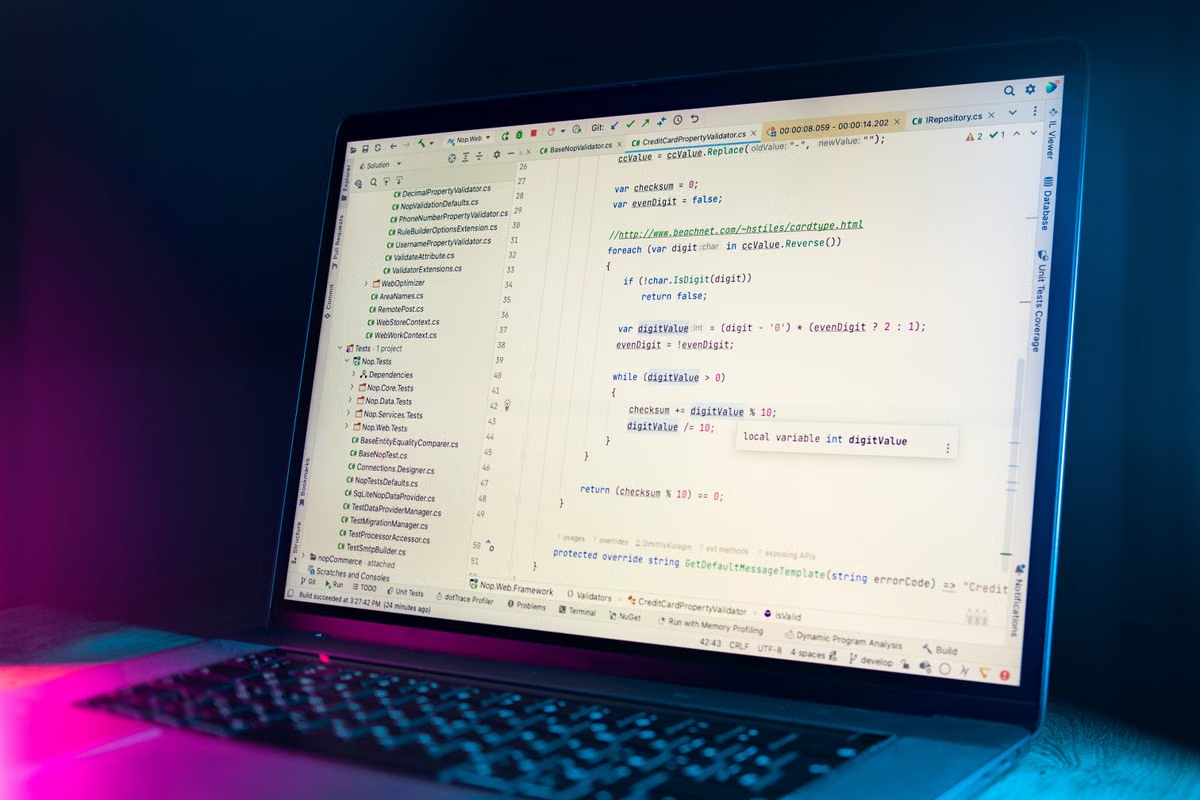
Platform engineers can share a business-level JSON Schema across OpenAI, Gemini, and Claude, but should not submit the same raw file to every API without review. This guide defines a compatibility subset, adapter checks, shared test cases, agent security controls, and release-blocking conditions.

Gemini 3.7 Flash shipped 13 August; Pro is still 3.1. There is no 3.5/3.6/3.7 Pro. Route by role: Flash for the default loop, Pro for hard cases, Nano Banana for pixels.

WWDC26 already showed iOS 27. Fall is about shipping Siri AI and system Apple Intelligence with iPhone 18, and being precise: Gemini refines AFM; it is not Google Assistant on the Home Screen. China and the EU still have switches.

No invite yet. The four-year pattern plus Labor Day points to 9 September 2026. Expect iPhone 18 Pro / Pro Max and a foldable iPhone; the standard 18 may wait until spring 2027. The software plot is context-aware AI Siri.
This guide explains how Agent Skills package stable domain knowledge and repeatable workflows into reusable folders. It covers SKILL.md structure, activation logic, references, scripts, MCP boundaries, security checks, and team governance.
This guide explains how PPT Master converts documents, web pages, Markdown, and topics into native PowerPoint files. It covers editable objects, template reuse, input formats, model dependencies, visual preview, and the checks required before delivery.
This comparison ranks Orca, Claude Code, Cursor, and OpenHands by parallel execution, code isolation, deployment control, model flexibility, security, and operational effort. It gives conditional recommendations for individual developers, macOS teams, model-neutral platform teams, and hosted asynchronous development workflows.

Customer service automation, faster dev cycles, data analysis agents, and end-to-end process automation — four core enterprise Agent use cases with architecture guides.

Semantica lets Claude Code retain codebase understanding and project preferences across sessions. Full guide to Memory Store, Retrieval layer and persistence config, with pitfall notes and Cloud Mac best practices.

How much does the free tier give you? What do Pro and Team plans cost? We break down usage billing with monthly estimates for solo devs, small teams, and enterprises.

Full pipeline breakdown: PDF parsing, Embedding, vector storage to Skill packaging — with per-stage cost estimates and Cloud Mac M4 benchmarks.

End-to-end V3/R1 tuning: vLLM & SGLang params, FP8/INT4 quantization, KV cache & prefix caching, fast/slow pools, API vs self-hosting—with hardware and launch checklist.

Top 5 with GitHub Stars: Mem0 ~62k leads overall, Cognee for knowledge graphs + MCP, Zep/Graphiti for temporal facts, Letta for autonomous agents, LangMem for LangGraph—with scenario matrix and deployment tips.

Top 4 ranking and selection matrix: Docling for enterprise open source, MinerU for Chinese papers and formulas, Marker for English batch Markdown, LlamaParse for managed API—with hands-on CLI, RAG integration, and Cloud Mac deployment notes.

Open-source Agent editing from raw footage to final.mp4: ElevenLabs word-level transcription, FFmpeg render, self-eval loop, and Cloud Mac deployment for talking heads and launch reels.

Top 5 ranking and scenario matrix: Cursor leads IDE Agents, Claude Code for terminal reasoning, Copilot for GitHub, Codex for API integration, Gemini for long-context value—with combo strategies and budget tips.

A 2026 hands-on ranking from codecrafters-io/build-your-own-x: Git, databases, Redis, Shell, HTTP Server, containers, and neural networks among 30 projects sorted by engineering value—with a must-do list of 7 and learning paths for backend, mobile, and AI engineering.
This guide helps developers isolate OmniRoute Remote Mode failures without immediately reinstalling the gateway. It covers service health, network reachability, access tokens, reverse proxies, client context, streaming requests, and post-fix acceptance tests.
This guide shows independent developers and small teams how to move an AI Agent from a local project to a production service with OpenShip. It covers deployment shape, build inputs, model API keys, databases, background workers, domains, logs, rollback, and final acceptance checks.

This guide shows DevOps engineers how to add Xcode 27 without replacing a stable Xcode 26.6 production node. It covers Apple Silicon requirements, runner registration, automatic startup, workflow isolation, signing validation, rollback, and the security boundaries required for a remote Mac build host.

PAT auth · OpenAI compatible · free rate limits · Actions · retirement migration

Ai4 2026 trends · Agents · RAG · World Models · LLMOps

mosh · tmux · ripgrep · rsync · mise · five-layer picks

M4 compute nodes · cloud Xcode · Swift tuning · seamless remote debug

DerivedData · SPM · CocoaPods · multi-runner sync

Golden images · Xcode snapshots · Ansible · Cloud Mac automation

Unified memory · Swift compile pipeline · Linker bandwidth · Cloud Mac build nodes

SSH port forwarding · lldb · debugserver · Cloud Mac debug pipeline

Regional review differences · Signing identity isolation · US East/West/APAC build placement · TestFlight handoffs

Xcode version pinning · US East/West/APAC runner placement · Signing sync and TestFlight handoffs

Launch double quota extended to July 21 · First-Party Models pool · Billing verification and deal guide

Ryzen AI 400 incremental refresh · Consumer Zen 6 delayed to 2027 CES · Scenario-based buying advice

July 22–23 San Francisco · Lisa Su keynote · YouTube live · MI450 / Helios / MI500 preview

VS Code · Cursor · Claude Code hands-on test · HID mapping · July 15 launch preview

Complete iPhone / iPad / Mac list · Siri AI advanced tier · unsupported models · setup & region limits

Three-mode super desktop · Work's five core capabilities · developer migration · vs Cowork

Performance, price & speed compared · Terra default, Sol for hard problems · max/ultra · explicit caching

The Sol/Terra/Luna family · government-reviewed limited preview · full API pricing · ChatGPT rollout status

2026 guide · Pro from $17 · Max 5x/20x · scenario picks · monthly cost

2026 practical · idea validation · AI-built MVP · launch & payments · 30-day checklist

DeepSeek V4 · Qwen · 50% tokens · open weights · Agent surge · five signals for model choice

Plain English · Intel can’t upgrade · AI needs M chip · swap your build Mac · simple checklist

Desk-bound → mini · mobile → MBP · RAM before chip · hidden costs · scenario matrix · TCO · Cloud Mac third option

Trackpad gestures · traffic-light windows · top menu bar · Cmd shortcuts · Finder paths · installs & sleep · try Cloud Mac without buying

Employment, freelance, and indie publishing share Swift—but their business models barely overlap. Salary bands, App Store splits, and hidden costs broken down: who's still earning steadily in 2026.

Default Opus, context snowballing, exploration tax, wrong billing mode—four weeks of real bill forensics and 8 moves to pull Claude Code monthly spend back to three digits without killing output.

Dual rolling quotas (5h + Weekly) maxed out? Saved reset tokens, mini downgrade, Credits, plan upgrades, and API / Claude Code fallbacks—seven paths to restore agent dev rhythm.

In the era of AI-written PRs, "can code" shifts from memorizing syntax to review and delivery. Seven testable predictions: job structure, education split, Apple-ecosystem premium, agent orchestration, and Cloud Mac as the default workflow.

Full price sheet for GPT-5.5, Claude Opus, Gemini 3.1, DeepSeek V4—from $0.10 to $180/M tokens, SWE-bench tiers, and audience matrix for real bills.

Ternus takes the CEO role Sept 1; hardware pace plus Apple Intelligence may shrink the "still good" window for older iPhones—how iOS teams should respond.

Model races hit diminishing returns; agents need 7×24 Mac nodes for xcodebuild and tmux—supply logic, four metrics, team choices.
Anthropic's first public Mythos model: long-horizon autonomy, SWE-Bench Pro step change, safety fallback, and Claude Code workflow shifts—what developers should care about.

macOS shifts from desk hardware to on-demand infrastructure: five paths without a local Mac, split workflows, signing, TestFlight, and where Xcode Cloud stops.

The inflection is experiential gap plus A18 gating—not model benchmarks. Decision matrices, recommended stacks, and a 7-step plan for iOS 20 and CI scale-up.

Apple Intelligence 2.0, Siri agent mode, iOS 20, Xcode 18 AI completion, Swift 6.2, M5—ten features unpacked for developers, with CI/CD impact.

Siri graduated from voice shortcuts to a system execution engine. Apps won't vanish—they become callable capability modules. Intent, CI loops, Cloud Mac nodes.

Usually not CPU—it's CocoaPods, SPM, and DerivedData cache setup. Full workflow examples; warm builds often drop 30–60%.

Same PR: 6 min one run, 18 the next? Split cold/warm before cache or hardware. 14-day Shadow: warm P95 14:12→6:05.
Windows developers / startups / CI power users — iOS build decision guide for three scenarios. Five quantified rules: under 200 builds/month doesn't justify dedicated hardware; teams under 3 people save with Cloud Mac rental; CI-heavy teams benefit most from a dedicated Mac node.

500 builds/month: GitHub Actions costs $320 in fees + $1,250 in hidden engineer wait time = $1,570 total. Dedicated Cloud Mac: $120/month. Full TCO breakdown, break-even calculator, and MacStadium comparison.

Pillar hub: −57% P95, waterfall chart, and a 5-article SEO cluster map. Queue, slow builds, cache, ROI, and architecture route to dedicated articles.

Windows developers rent Mac: <30 builds/year → rent by default. Decision model, Flutter team case study, cost comparison, and SSH workflow—run xcodebuild once before you buy.

Not an encyclopedia—customer stories, CI 14→6 min, a blunt Mac VPS take, and pitfalls we see in support tickets.

What/why/how entry plus TOC: macOS requirement, runner architecture, cache→memory→signing decision model, 4-step deploy, wall-clock benchmarks, and FAQ—scaling options at the end.

Reference architecture for three layers — repo agents, Memory OS, OpenClaw Gateway — with bridge patterns, Cloud Mac topology, and L0–L3 maturity. Not one super chat.

Unrelated diff down 78%, first-pass CI +30pp — constant-edit failure case, copy-paste CLAUDE.md, Cloud Mac tmux long-run setup.

Opus 4.8 ships Dynamic Workflows, Effort control, cheaper Fast mode, and more honest agents—not just benchmark points. How iOS/AI teams pair Claude Code with Cloud Mac for overnight repo-scale runs.
Intel Mac runners vs M4 Pro: typical build-time ranges, engineering-hours ROI formula, buy vs Cloud Mac TCO, plus a 6-step Intel→Apple Silicon migration HowTo and FAQ.

OpenHuman local Skills (SKILL.md + openhuman-skills catalog) vs ChatGPT GPTs—why Silicon Valley devs care, runtime migration notes, and Mac mini M4 Cloud Mac deployment for 24/7 agent workflows.

Personal context, not psychotherapy—how OpenHuman Memory Tree ingests Gmail, Slack, and calendar locally, why it beats ChatGPT Memory on breadth, and running Auto-fetch 24/7 on Mac mini M4 Cloud Mac.

Parser, index, and agent tooling crossing 10k+ stars—the 2026 bet is symbols + call graphs + hybrid RAG. Team checklist and Cloud Mac indexing for large Swift repos.

Full index, RAG, huge context—and you still catch missed call sites before merge. For Cursor and Claude Code teams: where cross-file agents get stuck (2026).

OpenHuman Memory Tree architecture: local SQLite, Obsidian wiki, Auto-fetch, agentmemory backend, and why AI developers run personal agents on Mac mini M4 Cloud Mac.

Compare Mac VPS, shared Mac hosting, and dedicated Cloud Mac for Xcode, Flutter, React Native, GitHub Actions, latency, cost, and release workflows.

A practical 2026 guide to Mac mini M4 AI on a dedicated Cloud Mac: MLX, Core ML, local inference, 16GB vs 24GB memory, GPU cloud trade-offs, and SSH-first setup.

Master your React Native iOS build workflow in 2026 with a dedicated Cloud Mac Mini M4—setup Node.js, Watchman, Xcode, CocoaPods, and CI/CD pipelines.

Ship Flutter iOS from Windows or Linux: dedicated Cloud Mac Mini M4 setup, CocoaPods, signing, ipa export, CI patterns, and cost vs buying a Mac.

Learn how to bridge the gap for iOS development on Windows. Professional guide to using dedicated cloud Mac Mini M4 for Xcode, Flutter, and React Native without the hardware upfront cost.

TCO and terminal-first vs screen-first paths; low-frequency peaks vs high continuous load, stability myths, and hybrid setups; 5-step HowTo and 8 FAQs—let your ledger decide. Paired zh and other locales.

Anchored on a rented Mac mini M4 cloud host in the data center: internal vs external TestFlight and upload hot-path placement; APAC SSH/VNC vs US sandbox batch checks; M4 memory/disk, parallel topology, daily/weekly/monthly rental—HowTo, isolation checklist, and 9 FAQs. Paired with the Simplified Chinese edition.

Co-locate runners with the hot path; six APAC anchors; memory and disk tiers; parallel build/execute/review topology; HowTo and FAQ—paired with the Simplified Chinese edition.

Open with a region × collaboration × workflow matrix; compare US coasts and APAC anchors, memory and disk tiers, rental structure, and a parallel split checklist without a Pro SKU—plus FAQ.
No matching articles found.
Need technical support or model selection advice?
Check the Help Center first; for ordering and pricing see the pricing page.
- support@vuncloud.com
- Tickets responded on business days
- Asia-Pacific and US West nodes

Multi-channel and multi-agent on a Mac cloud host: bindings routing, nodes pending/approve, region placement, 16/24GB and 1TB/2TB parallel splits; HowTo plus 10+ pairing troubleshooting FAQs.

Egress-first matrix: when to wrap wss in SSH -L, when to onboard straight to wss; region placement; 16 vs 24GB and disk for false “unstable link”; parallel splits; launchd PATH pitfalls; symptom FAQ—paired with the Chinese edition.
Official installer paths, doctor and gateway checks, region matrix for wss RTT, 16 vs 24GB, 1TB/2TB cache layout, split topology, and a symptom-first error FAQ—paired with the Chinese runbook.

Decide in order: region → compute tier → disk layout → topology. Put artifact paths and default region in metadata so cross-ocean fetch and cache drift do not eat determinism.

Orchestration layer + dedicated nodes: write triggers, builds, and receipts into an auditable pipeline.